W. Rogiest, K. Laevens, S. Wittevrongel, H. Bruneel; Heuristic performance model of optical buffers for variable length packets, accepted for publication in Photonic Network Communications, 24 July 2013The postprint is available here.
Monday, August 12, 2013
Article published in Photonic Network Communications
A new article in a nice journal...


Tuesday, June 19, 2012
QTNA 2012 · Kyoto · 1 August 2012



Short notice, but this cannot go unmentioned... you are cordially invited to participate in the 7th International Conference on Queueing Theory and Network Application (QTNA2012) in Kyoto, Japan, on August 1-3, 2012.
An invitation I post here as TPC member, but also as fan: this year QTNA is hosted and organized by the team of professor Yutaka Takahashi, who was my kind host during my stay in Kyoto (26 September - 23 December 2012).
For more information, see the CFP and the conference's website.
ICN 2013 · Sevilla · 27 January 2013
The Twelfth International Conference on Networks (ICN 2013) is held January 27 - February 1, 2013 in Seville, Spain. As member of the technical program committee member, I cordially invite you to participate. A call for papers.
***
| Call for Papers |
ICN 2013 is organized by and for academic, research and industrial partners.
We solicit both academic, research, and industrial contributions. ICN 2013 will offer tutorials, plenary sessions, poster sessions, panels, and exhibition opportunities. Best papers will be forwarded for consideration in a special issue of a journal. A best paper award will be granted by the IARIA award selection committee.
We solicit both academic, research, and industrial contributions. We welcome technical papers presenting research and practical results, position papers addressing the pros and cons of specific proposals, such as those being discussed in the standard fora or in industry consortia, survey papers addressing the key problems and solutions on any of the above topics short papers on work in progress, and panel proposals.
Industrial presentations are not subject to the format and content constraints of regular submissions. We expect short and long presentations that express industrial position and status.
Tutorials on specific related topics and panels on challenging areas are encouraged.
The topics suggested by the conference can be discussed in term of concepts, state of the art, research, standards, implementations, running experiments, applications, and industrial case studies. Authors are invited to submit complete unpublished papers, which are not under review in any other conference or journal in the following, but not limited to, topic areas.
All topics and submission formats are open to both research and industry contributions.
1. Communication theory
2. Communications switching and routing
3. Communications modeling
4. Communications security
5. Computer communications
6. Distributed communications
7. Signal processing in communications
8. Multimedia and multicast communications
9. Wireless communications (satellite, WLL, 4G, Ad Hoc, sensor networks)
10. Next generation networks [NGN] principles
11. Storage area networks [SAN]
12. Access and home networks
13. High-speed networks
14. Optical networks
15. Peer-to-peer and overlay networking
16. Mobile networking and systems
17. MPLS-VPN, IPSec-VPN networks
18. GRID networks
19. Broadband networks
20. Quality of service, service level agreement [QoS/SLA]
21. Reliability, availability, serviceabiliy [RAS]
22. Traffic engineering, metering, monitoring
23. Voice over IP services
24. Performance evaluation, tools, simulation
25. Network, control and service architectures
26. Network signalling, pricing and billing
27. Network middleware
28. Telecommunication networks architectures
29. On-demand networks, utility computing architectures
30. Applications and case studies
31. NGN protocol design and evaluation
32. NGN Standard Activities [ITU, TMF, 3GPP, IETF, etc.]
33. NGN Device Instrumentation
34. Network Management, scheduling and policy
35. NGN policy-based control
36. Networks policy-based management
37. Management of autonomic networks and systems
38. Vehicular Networks
2. Communications switching and routing
3. Communications modeling
4. Communications security
5. Computer communications
6. Distributed communications
7. Signal processing in communications
8. Multimedia and multicast communications
9. Wireless communications (satellite, WLL, 4G, Ad Hoc, sensor networks)
10. Next generation networks [NGN] principles
11. Storage area networks [SAN]
12. Access and home networks
13. High-speed networks
14. Optical networks
15. Peer-to-peer and overlay networking
16. Mobile networking and systems
17. MPLS-VPN, IPSec-VPN networks
18. GRID networks
19. Broadband networks
20. Quality of service, service level agreement [QoS/SLA]
21. Reliability, availability, serviceabiliy [RAS]
22. Traffic engineering, metering, monitoring
23. Voice over IP services
24. Performance evaluation, tools, simulation
25. Network, control and service architectures
26. Network signalling, pricing and billing
27. Network middleware
28. Telecommunication networks architectures
29. On-demand networks, utility computing architectures
30. Applications and case studies
31. NGN protocol design and evaluation
32. NGN Standard Activities [ITU, TMF, 3GPP, IETF, etc.]
33. NGN Device Instrumentation
34. Network Management, scheduling and policy
35. NGN policy-based control
36. Networks policy-based management
37. Management of autonomic networks and systems
38. Vehicular Networks
INSTRUCTION FOR THE AUTHORS
Authors of selected papers will be invited to submit extended versions to one of the IARIA Journals.
Publisher: XPS (Xpert Publishing Services)
Archived: ThinkMindTM Digital Library (free access)
Prints available at Curran Associates, Inc.
Articles will be submitted to major indexes.
Archived: ThinkMindTM Digital Library (free access)
Prints available at Curran Associates, Inc.
Articles will be submitted to major indexes.
Important deadlines:
| Submission (full paper) | September 2, 2012 |
| Notification | October 20, 2012 |
| Registration | November 4, 2012 |
| Camera ready | November 4, 2012 |
Only .pdf or .doc files will be accepted for paper submission. All received submissions will be acknowledged via an automated system.
Regular Papers (up to 6-10 page article)
Final author manuscripts will be 8.5" x 11", not exceeding 6 pages; max 4 extra pages allowed at additional cost. The formatting instructions can be found on the Instructions page. Helpful information for paper formatting can be found on the here.
Your paper should also comply with the additional editorial rules.
Once you receive the notification of paper acceptance, you will be provided by the publisher an online author kit with all the steps an author needs to follow to submit the final version. The author kits URL will be included in the letter of acceptance.
Work in Progress (short paper up to 4 pages long)
Work-in-progress contributions are welcome. Please submit the contributions following the instructions for the regular submissions using the "Submit a Paper" button and selecting thecontribution type as work in progress. Authors should submit a four-page (maximum) text manuscript in IEEE double-column format including the authors' names, affiliations, email contacts. Contributors must follow the conference deadlines, describing early research and novel skeleton ideas in the areas of the conference topics. The work will be published in the conference proceedings.
For more details, see the Work in Progress explanation page
Posters (poster or collection of 6 to 8 slides, including industrial presentations)
Posters are intended for ongoing research projects, concrete realizations, or industrial applications/projects presentations. Acceptance will be decided based on a 1-2 page abstract and/or 6-8 .pdf slide deck submitted through the conference submission website. The poster may be presented during sessions reserved for posters, or mixed with presentation of articles of similar topic. The slides must have comprehensive comments. One big Poster and/or the associated slides should be used for discussions, once on the conference site.
For more details, see the Posters explanation page.
Ideas (2 page proposal of novel idea)
This category is dedicated to new ideas in their early stage. Contributions might refer to PhD dissertation, testing new approaches, provocative and innovative ideas, out-of-the-box, and out-of-the-book thinking, etc. Acceptance will be decided based on a maximum 2 page submission through the conference submission website. The contributions for Ideas will be presented in special sessions, where more debate is intended. The Idea contribution must be comprehensive, focused, very well supported (details might miss, obviously). A 6-8 slide deck should be used for discussions, once on the conference site.
For more details, see the Ideas explanation page.
Technical marketing/business/positioning presentations
The conference initiates a series of business, technical marketing, and positioning presentations on the same topics. Speakers must submit a 10-12 slide deck presentations with substantial notes accompanying the slides, in the .ppt format (.pdf-ed). The slide deck will not be published in the conference’s CD Proceedings. Presentations' slide decks will be posted on the IARIA's site. Please send your presentations to petre@iaria.org.
Tutorials
Tutorials provide overviews of current high interest topics. Proposals should be for three hour tutorials. Proposals must contain the title, the summary of the content, and the biography of the presenter(s). The tutorials' slide decks will be posted on the IARIA's site. Please send your proposals topetre@iaria.org
Panel proposals
The organizers encourage scientists and industry leaders to organize dedicated panels dealing with controversial and challenging topics and paradigms. Panel moderators are asked to identify their guests and manage that their appropriate talk supports timely reach our deadlines. Moderators must specifically submit an official proposal, indicating their background, panelist names, their affiliation, the topic of the panel, as well as short biographies. The panel's slide deck will be posted on the IARIA's site.
For more information, petre@iaria.org
Workshop proposals
We welcome workshop proposals on issues complementary to the topics of this conference. Your requests should be forwarded to petre@iaria.org.
Wednesday, January 27, 2010
Monday, January 4, 2010
IEEE Transactions on Communications paper published
It took a little time, but as I found out today (by browsing Web of Science), the paper with ToC has obtained the desired status 'published'.
W. Rogiest, K. Laevens, D. Fiems and H. Bruneel, Modeling the Performance of FDL Buffers with Wavelength Conversion, IEEE Transactions on Communications 57 Vol. 12 (2009),pp. 3703-3711. (doi:10.1109/TCOMM.2009.12.080040) [paper]
Wednesday, December 2, 2009
Photonic Technology Letter accepted
Good news in the inbox today.
From:
Date: Wed, Dec 2, 2009 at 12:16 PM
Subject: Photonics Technology Letters - Manuscript PTL-21031-2009.R1
Dear Dr. Rogiest:
I am happy to inform you that your paper, PTL-21031-2009.R1, "Exact Optimization Method for an FDL Buffer with Variable Packet Length," has been accepted for publication in the next available issue of Photonics Technology Letters.
[...]
From:
Date: Wed, Dec 2, 2009 at 12:16 PM
Subject: Photonics Technology Letters - Manuscript PTL-21031-2009.R1
Dear Dr. Rogiest:
I am happy to inform you that your paper, PTL-21031-2009.R1, "Exact Optimization Method for an FDL Buffer with Variable Packet Length," has been accepted for publication in the next available issue of Photonics Technology Letters.
[...]
Wednesday, November 18, 2009
Wednesday, October 21, 2009
Wednesday, July 29, 2009
AEUe, 2009
News from the AEUe editorial office today, 29 July 2009...
W. Rogiest, K. Laevens, D. Fiems and H. Bruneel; The Impact of Synchronization on the Performance of FDL Buffers; accepted for publication in the International Journal of Electronics and Communications (AEUe).
W. Rogiest, K. Laevens, D. Fiems and H. Bruneel; The Impact of Synchronization on the Performance of FDL Buffers; accepted for publication in the International Journal of Electronics and Communications (AEUe).
Sunday, January 25, 2009
Wednesday, November 21, 2007
Pictures of My Workplace


Ghent, Friday 16 November 2007, 12:10 pm. These three pictures are taken at the doorstep (backdoor) of my workplace.
Monday, November 5, 2007
Guust Flater Goes Academic
 At the left hand side, please observe Gaston Lagaffe. Born in 1957 in the mind of Belgian André Franquin, Gaston, known to the Flemish-speaking as Guust Flater, looks a little disturbed. Looks like he is thinking about... solar energy.
The myth was around for years, but I only checked for the first time today: rumour has it that our famous Belgian cartoon figure once published at the side of a professor affiliated with Ghent University.
Below the proof: yes he did.

The reference in full:
| Title: | The maximum efficiency of the conversion of solar energy into wind energy | |
| Authors: | de Vos, Alexis; Flater, Guust | |
| Affiliation: | Laboratorium voor elektronika en meettechniek, Rijksuniversiteit te Gent, Sint Pietersnieuwstraat 41, B-9000 Gent, BelgiumGuustFlaterFlater's Technology n.v., Bontinckstraat 83, B-9290 Berlare, Belgium | |
| Publication: | American Journal of Physics, Volume 59, Issue 8, pp. 751-754 (1991). | |
| Publication Date: | 08/1991 | |
| Origin: | AIP | |
| Keywords: | 140100170100SOLAR ENERGY CONVERSION, EFFICIENCY, LIMITING VALUES, WIND POWER, HEAT ENGINES, EARTH ATMOSPHERE, MATHEMATICAL MODELS | |
| Abstract Copyright: | (c) 1991: American Institute of Physics | |
| DOI: | 10.1119/1.16756 | |
| Bibliographic Code: | 1991AmJPh..59..751D |
Seems like reality beats fiction again.
Wednesday, October 31, 2007
Master's Degree, then PhD
Being asked today to provide a biography of three of my colleagues and myself (for inclusion in a paper), it sure hits me how the master's degree and PhD degree are written in many different ways.
Looking it up, I concluded the following...
For the master's degree, one can write correctly both (and only) MS and M.S. (Magister Scientiae) if one likes Latin and abbreviations. Or, one can stick to just writing master's degree (which I adopt as a standard from now on).
For the PhD degree, one can write correctly both Ph.D. and PhD (Philosophiae Doctor), but unfortunately is obliged to use a Latin abbreviation. (It's not that I do not like Latin, but rather that I'm fond of clarity.) To the best of my knowledge, there is no internationally accepted way to write a PhD title in full. (Hope someone invents it by the time I obtain one, but I doubt it. Please tell me in reply to this post if you know one.)
Looking it up, I concluded the following...
For the master's degree, one can write correctly both (and only) MS and M.S. (Magister Scientiae) if one likes Latin and abbreviations. Or, one can stick to just writing master's degree (which I adopt as a standard from now on).
For the PhD degree, one can write correctly both Ph.D. and PhD (Philosophiae Doctor), but unfortunately is obliged to use a Latin abbreviation. (It's not that I do not like Latin, but rather that I'm fond of clarity.) To the best of my knowledge, there is no internationally accepted way to write a PhD title in full. (Hope someone invents it by the time I obtain one, but I doubt it. Please tell me in reply to this post if you know one.)
Thursday, October 25, 2007
The real line dividing cultures
I like to share with you a not so new but by no means outdated article, entitled The real line dividing cultures (click to read), as published September 18th, 2005, in the International Harold Tribune.
Author Henry Fountain gives a well-argumented overview of the differences among cultures, analyzing the way in which they queue. As it often goes, the term European doesn't identify one type of people (here, queuers), but brings about a whole bunch of types...
This being a queueing research blog, I do not balk at mentioning that this suggests to call infinite-sized queues Asian, and finite-sized ones (with balking or reneging) American. Which leaves the term European queues for, err, a mix of queue jumpers (French and Italian) and decent customers (British), that is, some sort of priority queue? But this way of putting it is probably to laden to ever be adopted.
Some more about this (and also some discussion) can be found here.
Author Henry Fountain gives a well-argumented overview of the differences among cultures, analyzing the way in which they queue. As it often goes, the term European doesn't identify one type of people (here, queuers), but brings about a whole bunch of types...
Europeans, Rasulo added, "have very different attitudes about how they wait for things." At the Disneyland in Paris, while British visitors are orderly, French and Italians "never saw a line they couldn't be in front of."Also remarkable is the idea that American queues are in a way self-limiting (in queueing terms: people balk at entering) whereas Asian queues just tend to grow and grow.
Zhou said there was a tendency among Asians and others in more collective cultures to compare their situation with those around them.Spending some time in Asia (once Beijing once Singapore), I remember to have observed this difference too. (More precisely, I admired the peace and calm Asian people in a queue display.)
This may make it more likely that they will remain in a line even if it is excessively long.
Zhou said this finding was rooted in a somewhat paradoxical observation: that it is the people behind a person in line, rather than in front, that determine the person's behavior.
"The likelihood of people giving up and leaving the queue is lower when they see more people behind them," Zhou said. "You feel like you are in a better position than the others behind you."
By contrast, she said, Americans and others in more individualistic societies make fewer "social comparisons" of this sort. They do not necessarily feel better that more people are behind them, and dislike having too many people in front of them. Lines in these cultures tend to be self-limiting.
In a place like Hong Kong, however, the lines may just grow and grow. "The longer the line, people think the service is more worthwhile to get," Zhou said.
This being a queueing research blog, I do not balk at mentioning that this suggests to call infinite-sized queues Asian, and finite-sized ones (with balking or reneging) American. Which leaves the term European queues for, err, a mix of queue jumpers (French and Italian) and decent customers (British), that is, some sort of priority queue? But this way of putting it is probably to laden to ever be adopted.
Some more about this (and also some discussion) can be found here.
Monday, October 22, 2007
Web of Science, Don't Lead Us Astray
Check out the Web of Science homepage, and behold. A clear and stark interface, perfectly fit for its purpose: serving science. The upper half op the page looks as follows.

There's the nice and simple logo, some link to information for new users, and a very limited number of buttons (search options) —as should, in order to be user-friendly.
Yep, it shows that people spent time tailoring the interface down to the functional and elegant minimum they present us here. Mere utopia, when we browse from top to bottom. That is, until we arrive at the Quick search box.

What does Quick search mean? In a time where the majority of search box entries is tunneled through Google, we expect to get mostly the same as we get in Google: any result that contains the word we entered. We expect a bunch of hits, that might not be sorted in the most relevant order, but do indeed share this one feature: they contain the word we entered. This is what we expect, regardless of our opinion on Google, because search boxes in the noughties simply work this way, and this modus operandi has become second nature to the modal (web page) visitor.
And so I did: I entered my name, clicked the SEARCH button and beheld. This is what I was told.

What bad news! I am indeed searching for myself as an author, and although I'm quite sure I managed to get some articles published during my three years of research, my search finds no records. My oh my, did I then not publish after all?
I return to the home page and suddenly, it dawns on me: I was indeed warned. I should have known better, of course, since the little box at the home page,

warned me all the way. If you are looking for an author, use general search. And so I did, and found the deed done.
But that doesn't solve their problem. Two questions.
As for the second question, I'm not sure about the answer either. The welcome text in the search box states "Enter a Topic", so you'd figure that this Quick Search is intended to browse through topics. But the search hint on the WOS home page persistently counters this intuition, as it states: Looking for a topic [...]? Use General Search.
This leaves me puzzled, I assure you. Dozens of people, mostly scientists, are consulting WOS every day. Dozens of scientists, publishing on a variety of subjects that combine common sense and advanced science, are making the same useless loop as the one I describe here, this very moment.
Maybe there is some kind of humor in this, but I can't seem to grab it. Can anyone explain?

There's the nice and simple logo, some link to information for new users, and a very limited number of buttons (search options) —as should, in order to be user-friendly.
Yep, it shows that people spent time tailoring the interface down to the functional and elegant minimum they present us here. Mere utopia, when we browse from top to bottom. That is, until we arrive at the Quick search box.

What does Quick search mean? In a time where the majority of search box entries is tunneled through Google, we expect to get mostly the same as we get in Google: any result that contains the word we entered. We expect a bunch of hits, that might not be sorted in the most relevant order, but do indeed share this one feature: they contain the word we entered. This is what we expect, regardless of our opinion on Google, because search boxes in the noughties simply work this way, and this modus operandi has become second nature to the modal (web page) visitor.
And so I did: I entered my name, clicked the SEARCH button and beheld. This is what I was told.

What bad news! I am indeed searching for myself as an author, and although I'm quite sure I managed to get some articles published during my three years of research, my search finds no records. My oh my, did I then not publish after all?
I return to the home page and suddenly, it dawns on me: I was indeed warned. I should have known better, of course, since the little box at the home page,

warned me all the way. If you are looking for an author, use general search. And so I did, and found the deed done.
But that doesn't solve their problem. Two questions.
- Why does WOS provide a Quick Search box, that doesn't comply with any human intuition, and dwells on its very home page?
- What purpose does the Quick Search function serve?
- Does WOS try to make their interface look user-friendly, without providing the functionality? That would be really cheap.
- Or, alternatively, are they not aware that web intuition these days dictates that Quick Search always provides more, and never less results then a General Search (for the same keyword)? That would surprise me.
- Or are they just too lazy to adapt their interface to meet nowadays standards? That would be cheap again.
As for the second question, I'm not sure about the answer either. The welcome text in the search box states "Enter a Topic", so you'd figure that this Quick Search is intended to browse through topics. But the search hint on the WOS home page persistently counters this intuition, as it states: Looking for a topic [...]? Use General Search.
This leaves me puzzled, I assure you. Dozens of people, mostly scientists, are consulting WOS every day. Dozens of scientists, publishing on a variety of subjects that combine common sense and advanced science, are making the same useless loop as the one I describe here, this very moment.
Maybe there is some kind of humor in this, but I can't seem to grab it. Can anyone explain?
Wednesday, October 10, 2007
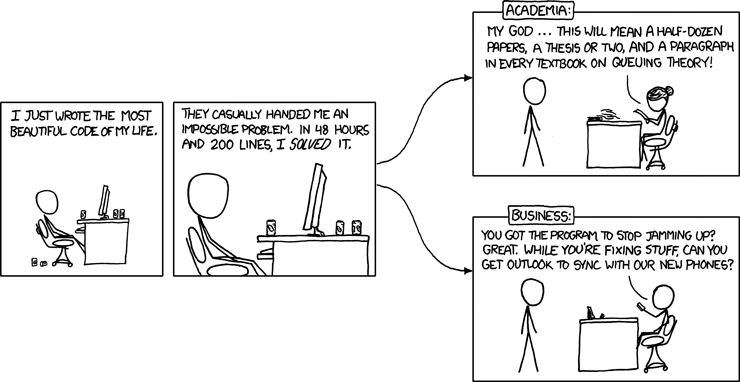
Academia, You Know Too Much
This article discusses on what I'd call the knowledge paradox: the more we know, the less important (and often the less true) our new findings are.
(Unfortunately it is written in my mother tongue Dutch instead of our world tongue English. Reference on top of first page. Click on images to see readable version.)
I'm not sure about the opinion of the author of this article —is there a way out of this paradox?— but I do think that any modern scientist should be aware of this.
There were times when all science was basic, and known only to the happy few. This basic knowledge has turned into school book wisdom for ages now.
Scientists nowadays are more concerned with non-basic, advanced problems —and they should, given these weird quantum effects and DNA inside us, and relativity all over the universe. A modern scientist is to solve very difficult problems, in the best possible way. This implies (rather serious) mistakes, all over —shit happens, when you're solving a billion pieces jigsaw puzzle.
Other pitfalls lure, however. In a worst case scenario, the scientist is still tackling the same old problem (that might be insolvable, or, worse, non-existing), and keeps himself busy complicating his theory of it. That is perhaps the largest (and most common) threat to scientific quality work nowadays.


PS These are pictures of sheets that I discovered hanging on the bulletin board of the ELIS Department of our university —thanks guys for sharing this.
(Unfortunately it is written in my mother tongue Dutch instead of our world tongue English. Reference on top of first page. Click on images to see readable version.)
I'm not sure about the opinion of the author of this article —is there a way out of this paradox?— but I do think that any modern scientist should be aware of this.
There were times when all science was basic, and known only to the happy few. This basic knowledge has turned into school book wisdom for ages now.
Scientists nowadays are more concerned with non-basic, advanced problems —and they should, given these weird quantum effects and DNA inside us, and relativity all over the universe. A modern scientist is to solve very difficult problems, in the best possible way. This implies (rather serious) mistakes, all over —shit happens, when you're solving a billion pieces jigsaw puzzle.
Other pitfalls lure, however. In a worst case scenario, the scientist is still tackling the same old problem (that might be insolvable, or, worse, non-existing), and keeps himself busy complicating his theory of it. That is perhaps the largest (and most common) threat to scientific quality work nowadays.


PS These are pictures of sheets that I discovered hanging on the bulletin board of the ELIS Department of our university —thanks guys for sharing this.
Wednesday, October 3, 2007
Publish Nor Perish
Publish or perish. I'm sure most researchers among us are familiar with this phrase, that refers to the pressure to publish work constantly in order to further or sustain one's career in academia.
And it's mostly true: we do need to disseminate results in written form. Applying it to my own case: what else would enable me to work further upon work of Italians (F. Callegati), Brazilians (R.C. Almeida), Hungarians (L. Lakatos),... without necessitating travel.
Extremely rare are those who glare with ideas across centuries without publishing. In academia I don't know any, actually. In general history...well there's such people as Sokrates, and Jesus, to name a few. They seem to go with a different adage: publish nor perish.
And it's mostly true: we do need to disseminate results in written form. Applying it to my own case: what else would enable me to work further upon work of Italians (F. Callegati), Brazilians (R.C. Almeida), Hungarians (L. Lakatos),... without necessitating travel.
Extremely rare are those who glare with ideas across centuries without publishing. In academia I don't know any, actually. In general history...well there's such people as Sokrates, and Jesus, to name a few. They seem to go with a different adage: publish nor perish.
Thursday, September 20, 2007
Are your papers crap?
From Citizendium blog, a comment on the paper “Why Most Published Research Findings Are False” (PLoS Medicine). Included: entertaining sarcastic remark by Larry Sanger.
Click here to read that.
Click here to read that.
Wednesday, August 29, 2007
Motivation of this research blog
 This research blog is devoted to the research I perform in the field of stochastic modeling. The latter being the methodology, the topic is optical buffers. Since October 2004, I work and publish on this strongly mathematics-related subject. Main players are: probabilities, Markov chains, generating functions and ergodicity conditions. I am affiliated with SMACS, TELIN, Ghent University, Belgium (see sidebar for links). I work closely together with K. Laevens, D. Fiems and H. Bruneel, all experts in the field of stochastic modeling. Recently, I also joined forces with J. Lambert, B. Van Houdt on a Markov-chain-based approach to optical buffers. Further, I am also involved in a stimulating collaboration with E. Morozov, for work on stability conditions for the case of, you name it, optical buffers.
Since January 2005, I disseminate my research activities through an academic page. The scope of this (additional) platform is to have an online spot that I can edit and update in an easy way. It serves to broadcast an online list of my publications, but also comes at hand for commenting on research in general.
All comment welcome!
Wouter B. Rogiest
aka. wrogiest | wouter7 | Wouter 
Ghent, 29 August 2007
Subscribe to:
Posts (Atom)